
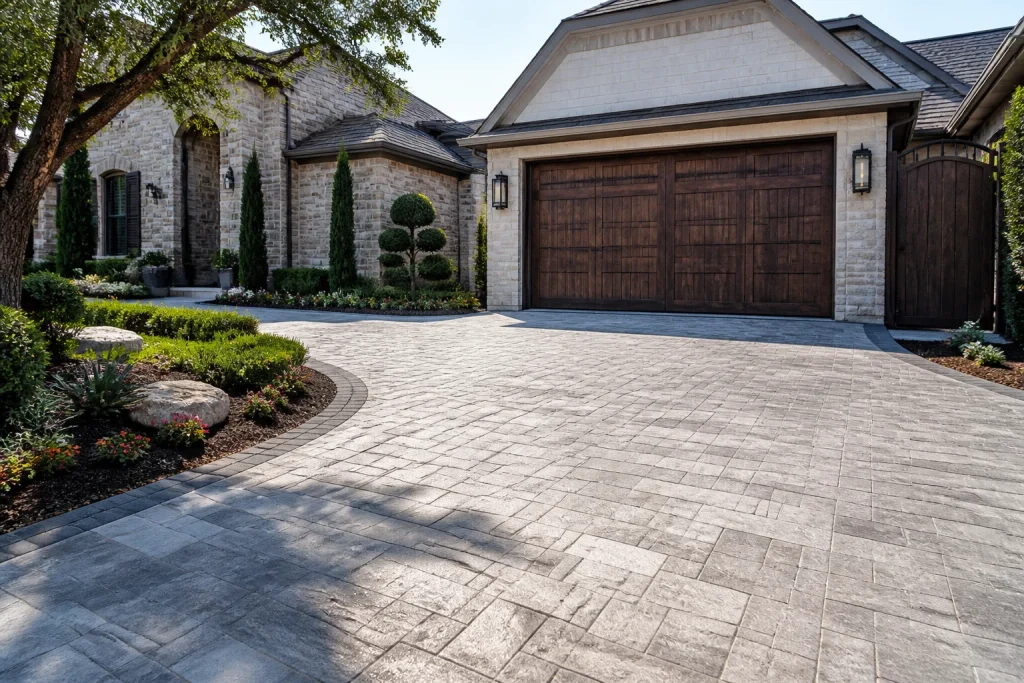
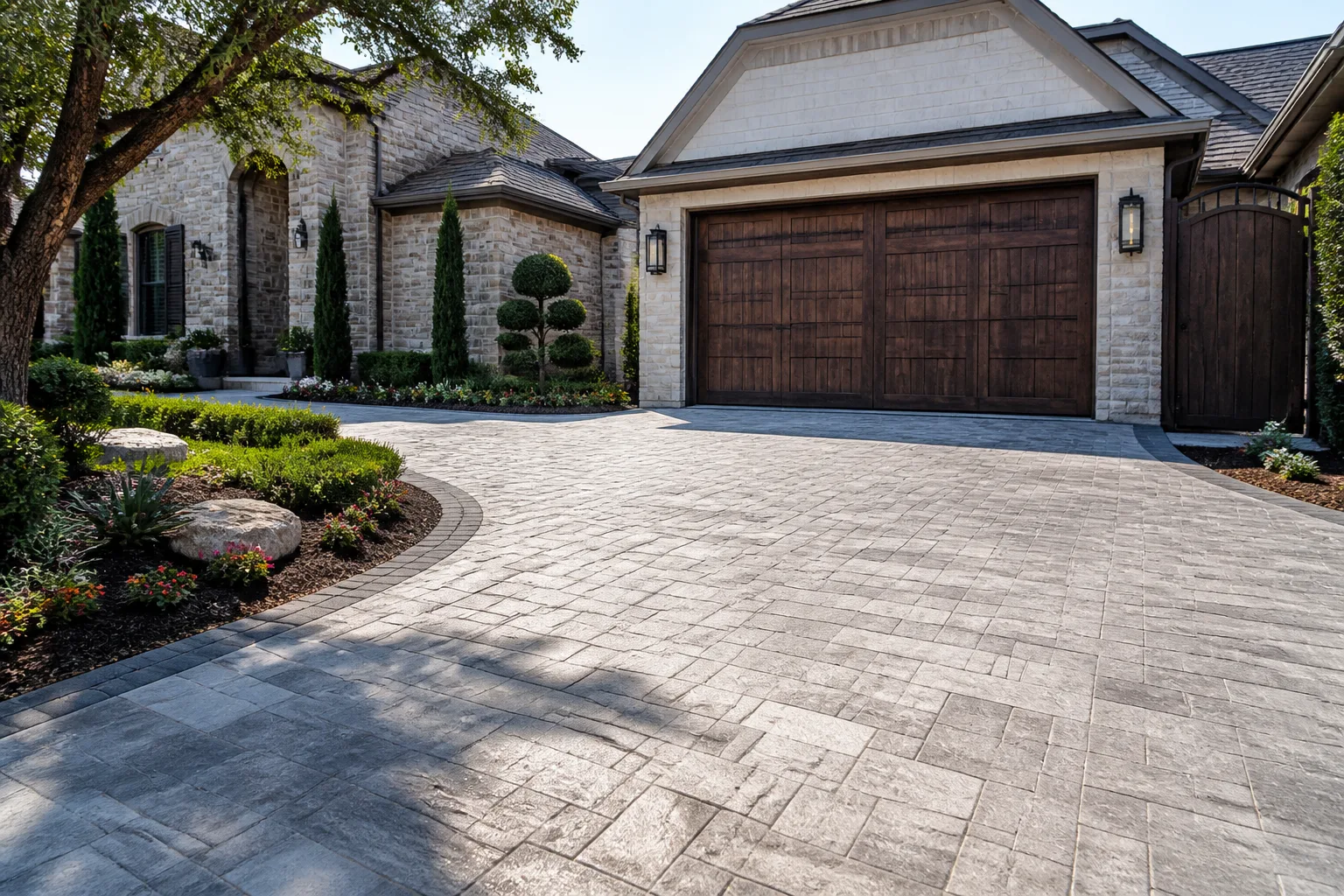
Blanco Driveway & Pavers in Dallas: A Homeowner’s Guide
Blanco stone is dense enough to outlast most of the houses it sits in front of, and that’s exactly why so many Dallas installs fail. Installers who treat Blanco like any other paver lay it on a base built for lighter material, skip the dry-fit, and seal it with a generic product. Within three North Texas freeze-thaw cycles, joints open, edges creep, and the surface chalks out. This guide covers what a Blanco driveway in Dallas actually requires to perform for decades, not seasons.
Key Takeaways
- Blanco’s weight per square foot demands a thicker compacted aggregate base than concrete pavers or clay brick – usually 6 to 8 inches, not the 4 inches many crews default to.
- Natural color variation means a staged dry-fit review before any base locking. Skip it and the finished driveway looks patchy from the street.
- North Texas UV and two Dallas summers will prematurely fade untreated Blanco stone. The sealer spec matters.
- Edge restraint is non-negotiable on Dallas’s sloped lots, where lateral migration is the number one cause of joint failure.
- On a 20-year horizon, Blanco often costs less per decade than stamped concrete – even though it costs more upfront.
Why does Blanco stone need a thicker base than other Dallas pavers?
Blanco natural stone runs heavier per square foot than concrete pavers, clay brick, or most manufactured alternatives. That extra mass is the whole point – it’s why the material feels substantial underfoot and why it holds color and texture for decades. But it also means the load transferred to the subgrade is higher, and the compacted aggregate base underneath has to carry it without settling.
For a Blanco driveway in Dallas, plan on 6 to 8 inches of compacted crushed aggregate, placed in 2-inch lifts and compacted between each one. The default many crews use – 4 inches over a thin sand bed – works fine for a lighter paver on a flat lot. Put 8 inches of Blanco on that same base and you’ll see rutting and joint separation within a couple of seasons, especially on any grade. Dallas soil is a mix of expansive clay and limestone shelf depending on where you are. A driveway in Lakewood sitting on clay behaves very differently from one in Preston Hollow where the rock is closer to the surface, and the base prep should reflect that.
Ask any installer you’re considering what base depth they plan for Blanco specifically – not for pavers in general. If the answer doesn’t reference the stone’s weight, keep looking.
Why does Blanco have to be dry-fit before it’s set?
Blanco is a natural stone, which means every pallet runs from cream to warm beige to deeper tan with visible veining. That variation is what gives a Blanco driveway its character – and what makes skipping the layout review a real mistake. Once mortar sets or the base locks, moving pieces means pulling them up and starting that section over.
Here’s how a proper Blanco install handles it:
- Stage the stone by tone. Open multiple pallets and blend pieces across the whole driveway footprint so no single area reads darker or lighter than another.
- Dry-fit the full field. Lay the stone on the compacted base without mortar or locking sand and walk the homeowner through it in daylight.
- Review the edges and the approach. The apron near the street and the transition at the garage are the two spots people look at every day – get the color blend right there first.
- Adjust before locking. Swap pieces, then lock the base and set. The final look is decided at this stage, not after.
We’ve seen driveways in the M Streets where the dry-fit was clearly skipped – one corner reads almost white while the main field runs warm tan, and no amount of cleaning fixes it. That’s a $12,000 to $25,000 driveway that looks like a patch job from the curb.
What sealer does Blanco need for Dallas summers?
Untreated Blanco stone in Dallas will look noticeably different after two summers. North Texas UV is brutal from roughly May through September, and natural stone that isn’t sealed will chalk, lose depth of color, and start holding dust and pollen in the surface pores. The fix is a penetrating sealer formulated for dense natural stone – not a film-forming concrete sealer, and not a wet-look product designed for stamped concrete.
A few specifics for Dallas:
- Penetrating, breathable sealer. It soaks into the stone and blocks moisture without trapping it. Film-forming sealers on Blanco can haze and peel under Dallas heat.
- UV-stable formulation. Ask for the manufacturer’s UV rating. Cheap sealers yellow or go milky, and on light Blanco stone that’s visible immediately.
- Reapply on a schedule. Typically every two to three years for a Dallas driveway that sees full sun, sooner on the western exposure.
- Seal after the stone has cured and dried. Sealing too early traps moisture and causes cloudy patches.
Do the math: an unsealed Blanco driveway in Dallas may need a full restoration – cleaning and re-sealing – well before its tenth year. A sealed one goes the distance.
Why does a Blanco driveway need edge restraint in Dallas?
Dallas lots slope, and a heavy Blanco paver field on a slope wants to migrate downhill. Without proper edge restraint, the outer pavers walk, joints widen, and the whole surface starts to loosen. This is the number one failure mode we see on Blanco installs that used a cheap plastic edge or none at all.
The right edge restraint for a Blanco driveway in Dallas is a rigid system – aluminum or steel edge, or a poured concrete curb on the high side – anchored into the base, not just tucked against the soil. On steep grade lots in neighborhoods like Kessler Park or on the hills around White Rock Lake, the edge restraint also needs to handle water runoff. A Blanco driveway with a weak edge on a Dallas slope will show movement in the first fall rainy season. Fixing it later means pulling up pavers and rebuilding the edge – a several-thousand-dollar repair that should have been a few hundred dollars of edge restraint at install time.
When you get quotes, ask to see the edge detail drawn or described in writing. “We’ll finish it with edge” isn’t the same as a spec.
What does Blanco cost per decade in Dallas compared to stamped concrete?
Stamped concrete is cheaper upfront. That’s the honest answer. A stamped concrete driveway in Dallas runs roughly $8 to $14 per square foot; Blanco natural stone with proper base, edge restraint, and sealer runs roughly $18 to $30 per square foot depending on stone selection and site conditions. On a 600-square-foot driveway, that’s a real gap.
But stamped concrete in Dallas doesn’t sit still. The freeze-thaw cycle that runs from late November into March cracks stamped concrete sections, pops the surface, and fades the color within 10 to 15 years. Resurfacing or replacing is a real cost, often before the second decade is out. Blanco stone, installed right, doesn’t crack. It can be re-sealed and brought back to full color. Its salvage value on a resale is real – buyers in Dallas recognize natural stone.
Here’s the rough per-decade math for a 600-square-foot driveway:
- Stamped concrete: ~$7,000 to $8,500 upfront, plus a likely $4,000 to $6,000 replacement or resurface in years 12 to 18.
- Blanco stone: ~$12,000 to $18,000 upfront, plus $400 to $800 in re-sealing every few years, and no replacement in 20 years.
Over 20 years, Blanco often lands within 10 to 15 percent of stamped concrete – and sometimes under it once you count a replacement. That’s before you count the first owner’s enjoyment of the surface or the resale bump. Upfront pricing, no surprises – the number you see is the number you pay.
When to call a pro
Blanco installation is one of those jobs where the gap between “looks fine” and “will perform” is invisible once the pavers are down. If you’re considering a Blanco driveway in Dallas, get at least two installers who can speak specifically to base depth for the stone’s weight, dry-fit layout, sealer spec for North Texas UV, and edge restraint on your lot’s grade. If a quote treats Blanco like any other paver, that’s your signal.
We’ve walked more than one homeowner through a failed Blanco install in Coppell they’d been told was “just settling.” It wasn’t settling. It was a base that couldn’t carry the stone. Our technicians have up to 12 years of experience with natural stone, and every Blanco project we complete is backed by our 730-Day Done Right Promise – if it’s not done right, we make it right. Calls are answered by a live person 24/7, and our technicians are background-checked and arrive in uniform.
Related services in Dallas: Driveway & Pavers in Dallas and Fence Installation in Dallas.
The Bottom Line
Blanco stone is a material that rewards the right install and punishes shortcuts. In Dallas, that means 6 to 8 inches of compacted base, a full dry-fit before setting, a UV-stable penetrating sealer, and rigid edge restraint on any slope. Do those four things and a Blanco driveway is a 25-to-30-year surface. Skip any of them and you’re looking at real problems inside three years of North Texas weather. On cost per decade, Blanco often beats stamped concrete – and the final driveway looks dramatically better doing it. You can start at our Groundwork Construction Co. of Dallas home page or explore Home Additions & ADU in Dallas if you’re planning a larger project alongside the driveway work.
If you’re in Dallas and want a Blanco driveway done right the first time, Groundwork Construction Co. of Dallas offers free project estimates and design consultations. Upfront pricing, no surprises, plus 0% financing for 18 months and $1,000 off projects over $10,000. Call (844) 797-4808 to schedule your free estimate.
Frequently Asked Questions
Blanco natural stone driveways in Dallas typically run $18 to $30 per square foot installed, depending on the stone selection, base conditions, and the grading of your lot. A 600-square-foot driveway lands roughly $12,000 to $18,000. Compare that to stamped concrete at $8 to $14 per square foot, and remember the Blanco install doesn’t carry a replacement cost in the second decade. Call (844) 797-4808 for an exact quote – estimates are free.
Yes, when they’re installed on the right base. Blanco natural stone itself is dense and freeze-thaw stable. The failure point is the base and joints, not the stone. A properly built 6-to-8-inch compacted aggregate base with rigid edge restraint and a UV-stable penetrating sealer lets a Blanco driveway in Dallas go decades without joint failure. Weak base prep is what causes movement, not the stone.
Typically every two to three years for a Dallas driveway with full sun exposure, and often every two years on a western exposure where UV is most intense. A UV-stable penetrating sealer is the right product – not a film-forming concrete sealer. Skipping re-sealing lets the stone chalk and fade, and the restoration cost climbs. Call (844) 797-4808 to talk through a sealer schedule for your Blanco driveway – the consultation is free.
Blanco costs more upfront because the stone itself is premium material, the base has to be deeper to carry its weight, and the install requires a dry-fit stage stamped concrete doesn’t. That higher upfront number often gets offset by stamped concrete’s 10-to-15-year replacement cycle. Over 20 years in Dallas, Blanco frequently costs within 10 to 15 percent of stamped concrete – and it still looks like stone, not a faded impression. Call (844) 797-4808 for a line-item comparison quote on your Dallas driveway.
Written by the team at Groundwork Construction Co. of Dallas.
Need Construction Help?
Call Groundwork Construction Co. of Dallas - licensed & insured, here with fast after-hours help in Dallas.
(844) 797-4808