
Driveway & Pavers: Repair or Replace? How Dallas Homeowners Decide
Repairing 30% of a failing paver driveway often costs 70% of a full replacement. Two years later, you’re standing in the same driveway, staring at the same problem, with less money in the bank and more frustration than the first time. The repair-or-replace call for Dallas pavers isn’t a gut feeling. It’s an engineering question, and once you know what contractors look for, you can spot the answer yourself before anyone hands you a quote.
Most Dallas homeowners come to this decision after a bad bounce in a contractor conversation. One guy says the pavers are fine and he can patch them for $2,400. Another says you need a full tear-out and rebuild. Both sound confident. Both have a truck and a business card. The difference between a good recommendation and a padded invoice usually comes down to whether the base underneath your pavers is holding or gone, and whether the surface still drains water away from the house the way it was designed to. If you’d rather not dig into that yourself, call (844) 797-4808 and we’ll walk you through it.
What Makes a Dallas Paver Driveway a Repair Candidate?
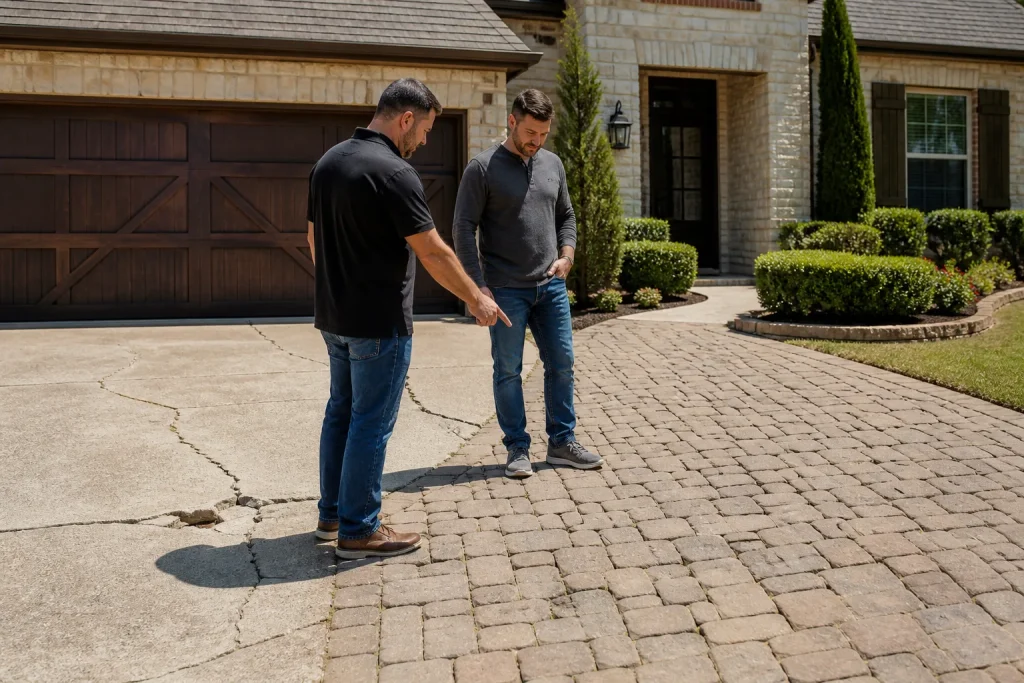
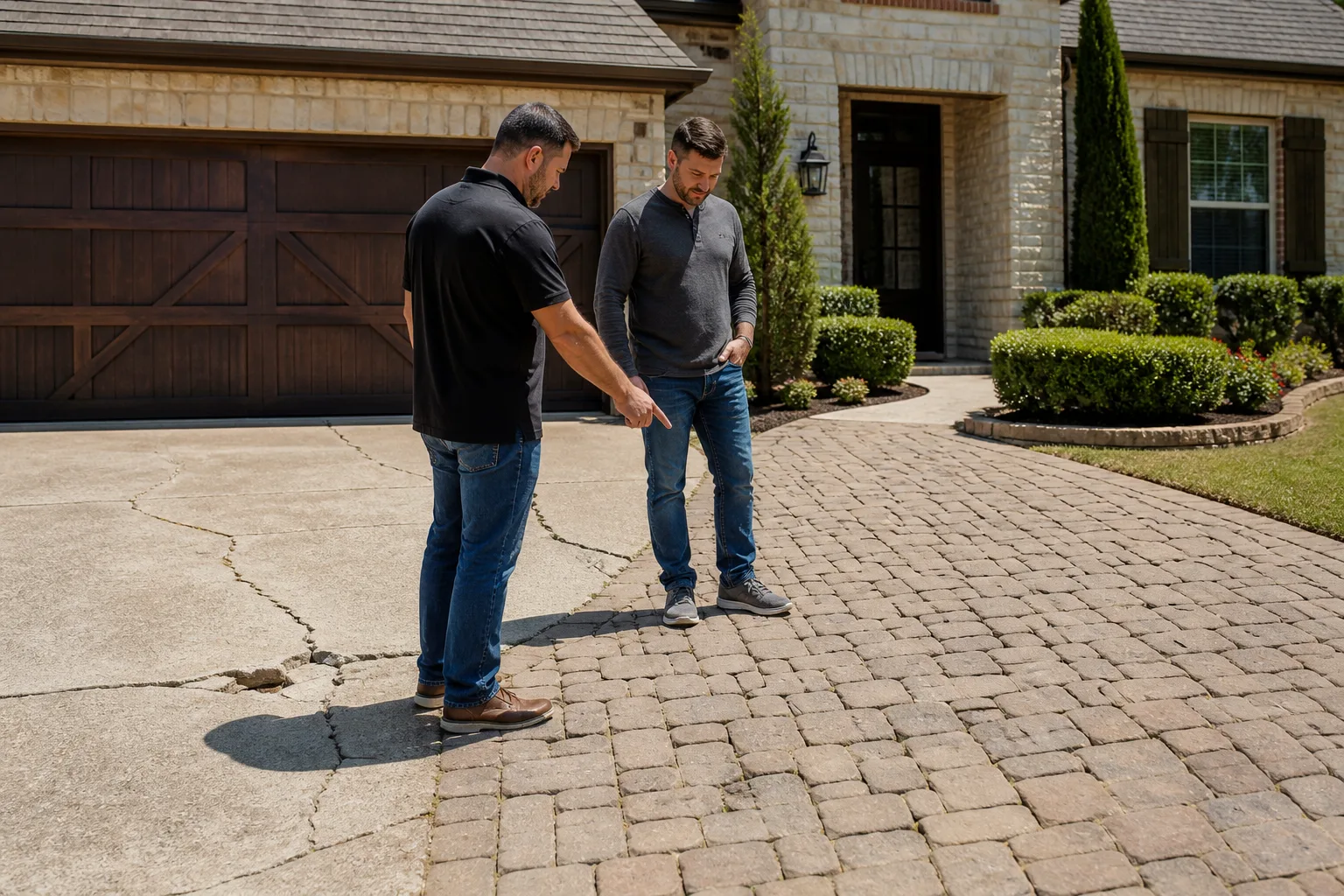
A paver driveway is a repair candidate when the surface damage is isolated, the base is intact, and the drainage is functioning. Localized settling, a handful of cracked pavers near the apron, or staining from tree sap and oil all fall into the repair bucket. The pavers themselves are the visible layer, and they’re the least expensive part of the system to fix. Repointing joints, replacing a few damaged units, and re-sanding are all manageable jobs if the foundation of the driveway is sound.
Here’s the test we use: walk the driveway with a screwdriver and push it into the joint sand. If it goes in easily and you feel loose material underneath, that’s a red flag. Sweep a hose across the surface and watch where water pools. If it drains toward the street, repair makes sense. If it sits in low spots next to the garage slab or drains toward the house, you’re looking at a base issue wearing a surface disguise.
- Good repair signs: isolated cracks, individual rockers, joint sand washout in one small area, cosmetic staining
- Bad repair signs: widespread settling in a pattern, water pooling near the foundation, soft joints across more than one section
In our experience across Dallas, about half of the driveways people assume need full replacement just need the top three to six inches of base reworked and the pavers re-laid. The other half need more.
Why Dallas Clay Soil Changes the Math
Dallas sits on expansive clay soil that swells when wet and shrinks when dry. That movement is the single biggest reason pavers fail here faster than in other Texas markets. Austin has rock closer to the surface. Houston has sandy soil that drains fast. San Antonio has a similar clay profile but typically less dramatic moisture swings. Dallas is the sweet spot for paver trouble: a clay base that moves more than most of the state and rainfall that arrives in hard bursts rather than steady soaking.
That movement is why a repair on a poorly-based driveway in Dallas often fails within two to three years. You fix the surface, the base keeps moving, and the pavers telegraph that movement right back up. When we look at a driveway in Lake Highlands or Preston Hollow, the first question isn’t “how many pavers are cracked?” It’s “how old is the base, and how does this soil react to the seasonal water cycle on this specific lot?”
Clay-rich neighborhoods like those around White Rock Lake tend to hold moisture longer, which means more swelling and more long-term stress. If your driveway sits at the bottom of a drainage swale or near a sprinkler head that dumps water along its edge, that’s a base failure waiting to happen regardless of how good the pavers looked when installed.
The Percentage-of-Affected-Area Framework
Before you call a single contractor, walk your driveway and estimate the percentage of pavers showing distress: cracks, rockers, sunken joints, offsets, missing sand. This gives you an objective number to compare against what any contractor recommends. The threshold contractors generally work from is roughly 25 to 30 percent.
- Under 15% affected: Repair makes sense. A patch-and-reset job will hold if the base around the affected area checks out.
- 15 – 25% affected: Borderline. This is where base condition and drainage decide the call. Get the base tested before committing to a repair.
- Over 30% affected: Replacement is almost always the better long-term spend. The math on repair stops working once you’re paying for tear-out, base prep, and paver reset on a third of the driveway. You’re paying replacement prices for a repair outcome.
That last point is the one most homeowners miss. Repairs aren’t priced linearly. Pulling up 30 percent of the pavers, re-grading the base, and resetting them costs roughly 70 percent of what a full tear-out and rebuild runs. You spend more than two-thirds of the replacement money and end up with a driveway that’s nine years old and patched.
How Age and Installation Quality Weigh In
If your driveway was installed in the last five years and the base was properly compacted with a solid drainage plan, you’re in repair territory unless the whole thing is failing. If it’s pushing 15 years old and was installed with a thin base layer like many of the driveway systems we see in older Dallas neighborhoods, a repair buys you a couple of years before the base gives out and you’re back where you started.
Installation quality is visible if you know where to look. Check the base layer depth at any exposed edge – a proper paver driveway in Dallas should have four to six inches of compacted aggregate under the bedding sand. Check the drainage pitch toward the street. Check whether the edge restraints are pinned and locked. If the original build skipped any of those, repairing the surface won’t fix what was wrong from day one.
Drainage history matters just as much. A driveway that has held up through five Dallas summers of shrink-swell cycles without shifting is a good sign. One that’s been patched twice already and still pools water next to the garage slab is telling you something the surface can’t hide.
When Two Contractors Disagree: How to Arbitrate
If one contractor recommends repair and another recommends replacement, the difference usually comes down to how each one evaluated the base. Ask both for the same three things and compare the answers directly:
- “How deep is the compacted base, and how did you check it?” A contractor who actually pulled up a paver to measure the base has an answer. One who eyeballed it from the driveway doesn’t.
- “How does the driveway drain toward the street?” Correct answers reference pitch, the slope of the apron, and where water exits the property.
- “What’s the workmanship warranty on your repair?” A repair recommendation from a contractor offering less than two years of coverage is a signal that they don’t trust their own work either. The workmanship guarantee we back all of our work with – the 730-Day Done Right Promise – exists for exactly this reason: a repair that fails in year two shouldn’t cost you anything extra.
Whoever recommends the cheaper option should be able to tell you exactly what’s wrong with the base and why the repair will hold. If they can’t, the higher recommendation is probably the honest one.
When to Call a Pro
Diagnosing base failure without digging is possible. Fixing it isn’t a homeowner job – it needs compacted base material, proper tear-out, and re-laying with correct drainage pitch, and mistakes show up in the second Dallas rainy season. If you’re at the 15 to 30 percent threshold or you’ve spotted soft joints near the house, that’s the point to bring someone out who can measure the base and read the pitch. The surface you can inspect yourself. The layer underneath the pavers is where the actual decision lives.
Related services in Dallas: if the driveway project exposes fence posts along the same property line that are sagging or leaning for the same base reasons, that’s worth having looked at in the same visit. Our Driveway & Pavers in Dallas team and our Fence Installation in Dallas team work the same lots and see the same soil. We install Belgard pavers and Jerith and Bufftech fencing systems regularly, and we’re glad to look at both while we’re on site. If your long-term plan involves a carport or garage addition off the back of the driveway, our Home Additions & ADU in Dallas team handles the pour and finish work in one pass instead of two.
Key Takeaways
- Repairing about 30% of a failing driveway usually costs near 70% of a full replacement – check the base before accepting a repair quote.
- Dallas clay soil swells and shrinks more than most Texas markets, so repairs on a bad base often fail within two to three years.
- Estimate the percentage of affected pavers yourself before calling anyone. Under 15% is usually a repair. Over 30% is usually a replacement.
- If two contractors disagree, ask both for base depth, drainage pitch, and repair warranty length – the answers decide the call.
The Bottom Line
The repair-or-replace question for Dallas pavers comes down to two things: how much of the surface is failing and whether the base underneath it is stable. Repair makes sense when the damage is isolated and the base checks out. Replace when the affected area creeps past 30 percent, when the base has already started to move, or when the drainage runs the wrong direction. Dallas clay soil makes the call more urgent here than in most Texas markets – a repair that ignores the base tends to cost you the repair twice.
If you’re in Dallas and want a straight read on which way your driveway should go, Groundwork Construction Co. of Dallas offers free estimates with written line-item pricing upfront, plus $1,000 off projects over $10,000 and 0% financing for 18 months if replacement turns out to be the honest answer. Every project is covered by our 730-Day Done Right Promise. Call (844) 797-4808 – a live person answers, day or night. You can also start from our Groundwork Construction Co. of Dallas home page to see the full scope of what we do across the metro.
Frequently Asked Questions
How much does paver driveway repair cost in Dallas?
Paver driveway repair in Dallas typically runs a few dollars per square foot for patching and re-sanding, with the total depending on how much of the surface is affected and whether base rework is needed. Once a repair quote climbs toward the cost of full replacement, that’s your signal to switch direction. Call (844) 797-4808 for a written line-item quote – estimates are free and pricing is upfront with no change-order surprises.
Can I repair just the damaged section of my paver driveway?
Yes, if the damaged section is isolated and the base beneath it is stable. The percentage framework is your guide – under 15 percent affected, a localized repair usually holds. Between 15 and 30 percent, the base condition decides it. Over 30 percent, replacement is almost always the better spend. Call (844) 797-4808 and we’ll help you read the number before you commit.
How long does a paver driveway last in Dallas?
A properly installed paver driveway in Dallas lasts 25 to 30 years with normal maintenance. The pavers themselves often outlast the base. Dallas clay soil moves the base below the pavers, so the limiting factor is usually base stability, drainage, and installation quality, not the pavers. That’s why a repair recommendation on a driveway with a failing base tends to fail again within two or three years.
Will replacement cost more than repair in the long run?
Almost never. A repair that buys two or three more years, followed by a replacement, ends up costing more than the replacement by itself. When the affected area passes 30 percent or the base has started to fail, replacement is the cheaper number over a ten-year window. Call (844) 797-4808 for a free estimate on both options before you decide.
Written by the team at Groundwork Construction Co. of Dallas.
Need Construction Help?
Call Groundwork Construction Co. of Dallas - licensed & insured, here with fast after-hours help in Dallas.
(844) 797-4808