
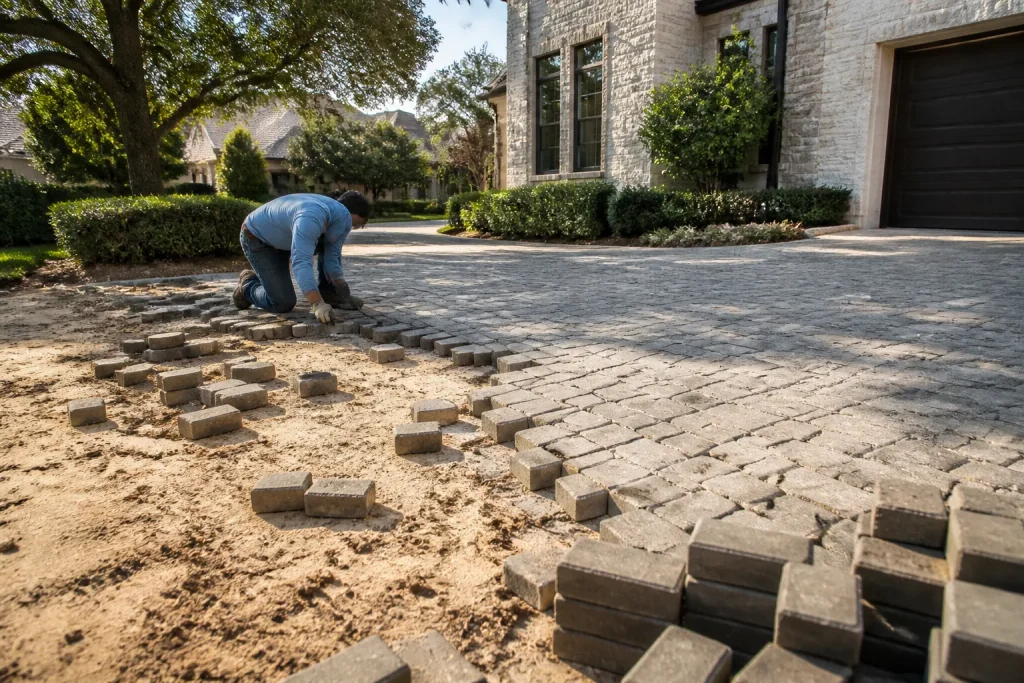
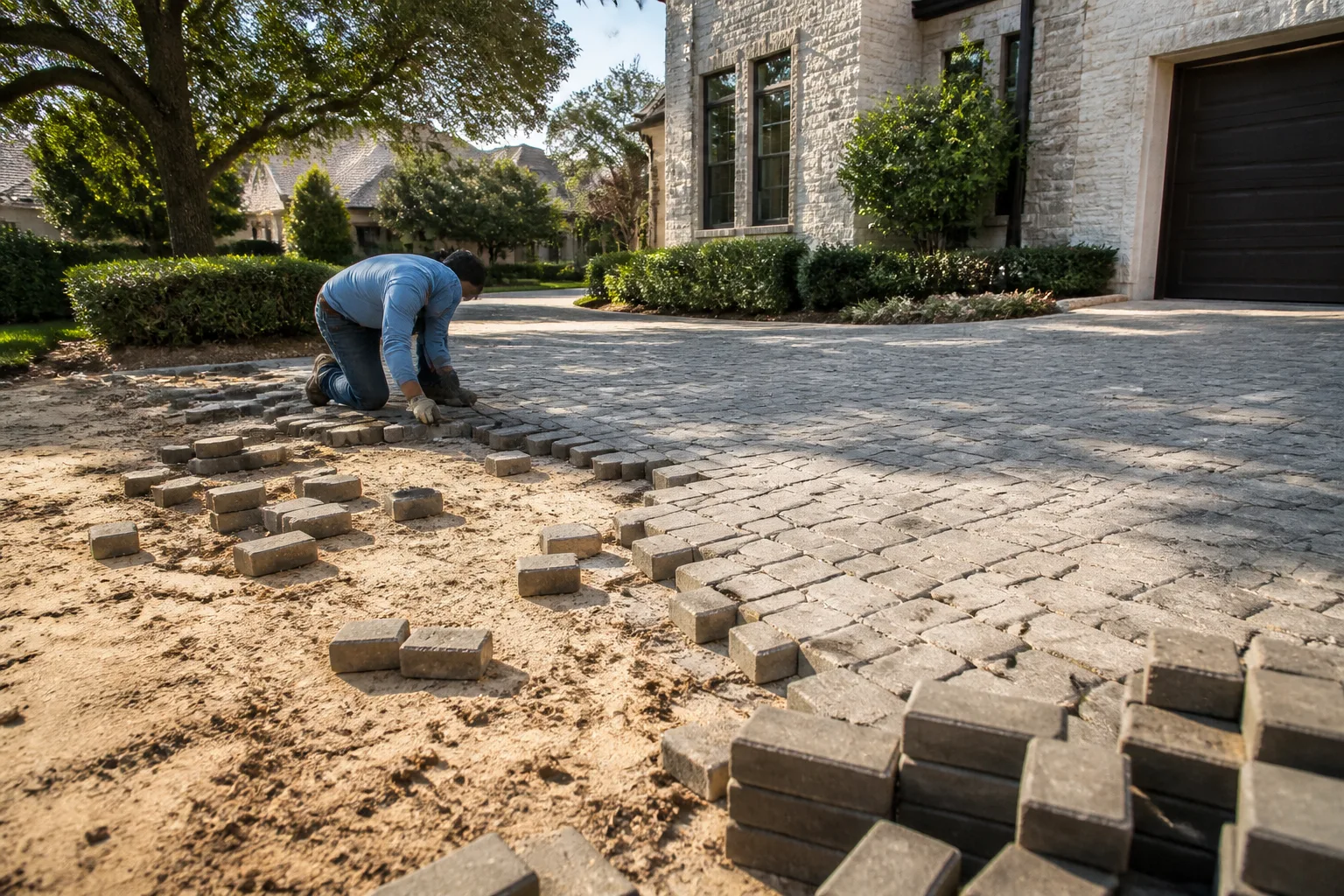
Emergency Driveway & Pavers Near Me: What Dallas Homeowners Should Do First
Your first move after a driveway failure is not to call three contractors – it’s to pick up a phone that also has a camera. In the first 30 minutes, document the damage with timestamped photos, pen the area off, and confirm that nothing is actively flooding or collapsing. Those 30 minutes decide whether insurance covers the repair or you pay out of pocket. If you’d rather have a trained eye look first, call (844) 797-4808 and we’ll walk you through it.
Key Takeaways
- Document damage before any temporary fix – no photos means no claim.
- Only certain failures count as true emergencies: active water intrusion, collapse risk, exposed hazards.
- Temporary stabilization is about safety and stopping spread, not making it look repaired.
- Verbal estimates and pressure to skip permits are the two loudest warning signs on a Sunday call.
- A legitimate first visit should end with a written scope, not a sales pitch.
What counts as a real emergency – and what can wait for Tuesday?
A genuine driveway emergency in Dallas is one where injury or property damage is occurring right now. Everything else is urgent but schedulable. The difference saves you from paying weekend rates for a problem that would cost a third as much on a weekday.
Count these as true emergencies:
- Water is actively running under or into the garage, foundation, or side yard because of a failed slope or broken drainage channel.
- A section has dropped or heaved enough that someone could step into it, roll a walker or wheelchair, or catch a tire – the trip and fall risk is real.
- Exposed rebar, loose edging, or a lifted paver that’s already been kicked across the driveway.
- A sinkhole or soft spot bigger than a dinner plate, which can signal subgrade failure rather than a surface issue.
These are urgent but not an emergency call:
- Hairline cracks.
- Mild settling of one corner.
- Moss or efflorescence.
- A paver that popped loose with a clean, flat base underneath.
- Ponding that shows up after every big storm but drains within a day.
We pulled a cracked paver off a driveway in Lake Highlands last spring where water had been trickling into the garage slab for two seasons. The homeowner had been calling it “just a puddle.” It wasn’t. That’s a real emergency. A crack running clean across a sun-exposed slab in the middle of a dry June? Not an emergency, and you shouldn’t let anyone tell you it is at 9 p.m. on a Saturday.
How do you document damage before anyone touches it?
Photograph everything before a single paver moves or a single bag of sand is dumped. Insurance adjusters and any honest contractor will tell you the same thing: once the damage is altered, the paper trail is broken, and it becomes almost impossible to prove what actually happened on your property in Dallas.
- Take wide shots first. Stand at the street and at the garage door. Get the whole driveway in frame, then zoom into the failure. Film a short walking video with your phone too – adjusters value it.
- Shoot for scale. Put a tape measure, shoe, or a $20 bill beside a crack, a heaved paver, or a sinkhole. A photo of a crack with no reference is worthless – a photo with a tape measure is not.
- Timestamp everything. Most phones stamp automatically. Confirm it’s on. If you’re using a real camera, photograph a piece of paper with the date and time on it in the first frame.
- Photograph the whole drainage picture. Capture downspouts, the low spot where water pools, the edge of the garage slab, and the sidewalk grading. In Dallas, water in a driveway is almost always about what’s upstream, not the pavers themselves.
- Photograph the property line. If a neighbor’s runoff, a builder’s dirt work, or a tree from the parkway is contributing, that matters. You want it on record.
- Keep receipts and a written log. Note the date, time, weather, and what you noticed when. If you did make any temporary fix (sandbag, board over a hole), log exactly what you did and photograph it.
Save the originals in two places – your phone and a cloud folder. Don’t crop, filter, or edit them. If your insurance company asks for these in Dallas, you want the untouched set. We’ve seen claims fail because a homeowner edited the exposure on a photo and it no longer matched the adjuster’s site visit.
What temporary stabilization can you safely do yourself?
You can protect people and stop the spread. You cannot rebuild. Don’t confuse the two. The goal in the first hour is to keep anyone from getting hurt and to keep water from doing more damage than it already has.
Safe steps for a Dallas homeowner:
- Block it off. Use cones, a trash can, or a sawhorse with a reflector. Move cars off the damaged lane – heavy vehicles on a soft subgrade make a bad spot worse overnight.
- Sandbag or divert running water. A single bag of play sand in a trash bag, placed in the water’s path, can keep it out of a garage door threshold. Do not dig trenches near a foundation.
- Cover the trip hazard, don’t hide it. A sheet of plywood over a small hole is fine if it’s flat and visible. Don’t tape a paver down and pretend it’s fixed – someone will step on it.
- Clear loose debris. Sweep up small broken pieces so nobody rolls an ankle, and bag the broken pavers – you may need them as a color match.
- Photograph the temporary fix. Yes, again. You want a record of what you added and when.
What you should not do: dig up a section to “see what’s underneath” near a foundation or utility line, jack up a heaved paver with a car jack, or run a hose into a sinkhole to test depth. Call 811 in Dallas before anyone digs deep, including you. Utility strikes are among the most expensive mistakes a homeowner can make and easiest to avoid.
What are the red flags when you call an emergency paver contractor in Dallas?
You’ll hear the same words from three different contractors on a Sunday. Only one of them is probably worth hiring. Here’s what separates a legitimate call from a costly one:
- Verbal-only estimates. If the number lives in the air and not on paper, it will change. A real written scope arrives by email or text, even on a weekend call-back.
- Pressure to waive permits. Some driveway and drainage work in Dallas requires permits; some doesn’t. A contractor who says “don’t worry about permits” without checking is a contractor who leaves you exposed to the city and to a future buyer’s inspector.
- A scope that starts with “we’ll just patch the top.” If a paver sank, the base beneath it failed. Patching the surface without addressing the base is a three-month fix at best.
- Cash only, no written contract, no verifiable business name, no address. The most expensive truck in Dallas can be a stranger.
- “We’ll finish it Tuesday” with no schedule. Vague timelines on a real emergency are a sign the crew is double-booked or the contractor is subbing it out.
- Price after the fact. If nobody tells you a range before the truck arrives, you’re not being quoted – you’re being billed.
Belgard and Techo-Bloc materials aren’t cheap, and a paver job that uses either is worth doing right the first time. A contractor who shrugs off the subgrade on a Belgard installation isn’t going to lay it to last anyway.
What should a legitimate Dallas paver contractor put in writing on the first visit?
Within the first visit – even on a Sunday – you should walk away with a written document, not a handshake. It doesn’t need to be the final contract; it needs to lock the essentials.
- A written scope. What’s being repaired, where exactly, and what’s not included. “Fix driveway” isn’t a scope. “Remove 6 pavers along garage apron, reset with base re-compaction and correct slope, replace broken units with matching product” is.
- A starting price range and what would move it. Subgrade findings, hidden rot, deeper base failure – these can change the number. The honest contractor says so upfront and in writing. Upfront pricing isn’t a promise the ground won’t surprise us; it’s a promise we won’t surprise you.
- Permit position. Whether a permit is required, whether they’ll pull it, and who pays.
- Insurance and licensing. A licensed and insured Dallas contractor should hand you proof without being asked twice.
- The warranty, in writing. Ours is the 730-Day Done Right Promise – if it’s not done right, we make it right. Any real warranty is on paper, not in a phone call.
- A timeline that names days, not vibes. “Temporary stabilization today, permanent repair 7 to 10 days out” is a timeline. “Soon” is not.
If the first visit ends without any of that, thank them for coming by and move on. You’ll be saving yourself the second payment three months down the road.
When should you call a pro in Dallas?
If water is moving into your garage, a section has dropped more than an inch, or the trip hazard is on a path a family member uses every day, call now. If the damage is stable and cosmetic, wait until Monday and get three written quotes. Nobody should be making permanent repairs on a Sunday at emergency rates for a driveway that isn’t actively failing.
When you’re ready to have it looked at properly, call us at (844) 797-4808. We answer live, 24/7 – no voicemail – and our technicians are background-checked and arrive in uniform. Whether the fix is a single paver reset or a full drainage rebuild with Tremron or Unilock product, we do it with the same warranty behind it.
Related services in Dallas: Driveway & Pavers in Dallas and Fence Installation in Dallas if storm damage hit your fence line at the same time. If you’re also planning ahead on a bigger buildout, our Home Additions & ADU in Dallas page covers the full-scope work. And you can always start at the Groundwork Construction Co. of Dallas home page.
The Bottom Line
The first 30 minutes after a driveway failure decide the next 30 days. Photograph before you fix, block the hazard, don’t dig, and demand a written scope on the first visit. Emergency paver work in Dallas isn’t about who answers fastest on a Sunday – it’s about who shows up with a written plan on Monday and stands behind it. If you’re in Dallas and need help, Groundwork Construction Co. of Dallas offers free estimates – call (844) 797-4808. All work is backed by our 730-Day Done Right Promise, and calls are answered by a live person any hour, any day.
Frequently Asked Questions
Temporary stabilization in Dallas typically runs $250 – $600 for a Sunday or after-hours visit. A permanent repair of a sunken section or heaved paver with base correction usually lands between $1,200 and $4,500, depending on the area and whether the base needs rebuilding. Full drainage corrections run higher. Call (844) 797-4808 for an exact quote – estimates are free.
Usually not for wear, settling, or poor installation – those are considered maintenance. Insurance typically covers sudden events, like a burst pipe under the driveway, a tree fall, or a vehicle impact. Document everything before touching the damage, then call your insurer. A written contractor scope helps the adjuster either way.
Not properly. Stabilization can happen the same day, but a real repair needs the base exposed, compacted, and reset – a process that takes at least a day of drying and correct installation on Belgard, Unilock, or Tremron product. Any contractor promising a permanent same-day paver fix on a Sunday is going to hand you a problem for next spring.
It depends on scope. Cosmetic paver resets usually don’t require a permit. Anything that changes the apron at the curb, the slope toward the street, or a drainage channel often does. A licensed contractor will tell you which side of the line your job falls on, in writing, before starting work.
What should you do while you wait for the contractor to arrive?
Three things, in this order: block the hazard, keep water moving away from the house, and finish your photo log. Then leave it alone. Pulling cars back onto a soft section, moving pavers around to see underneath, or rinsing mud toward the street all make things worse. Once you’ve done those three, you’re done until help arrives.
And while you wait, don’t answer the phone for the fourth “emergency driveway pavers near me Dallas” contractor unless you’re ready to compare written scopes side by side. The one who wins isn’t the one who called you back in 90 seconds – it’s the one who put a number, a scope, and a warranty on paper.
Written by the team at Groundwork Construction Co. of Dallas.
Need Construction Help?
Call Groundwork Construction Co. of Dallas - licensed & insured, here with fast after-hours help in Dallas.
(844) 797-4808