
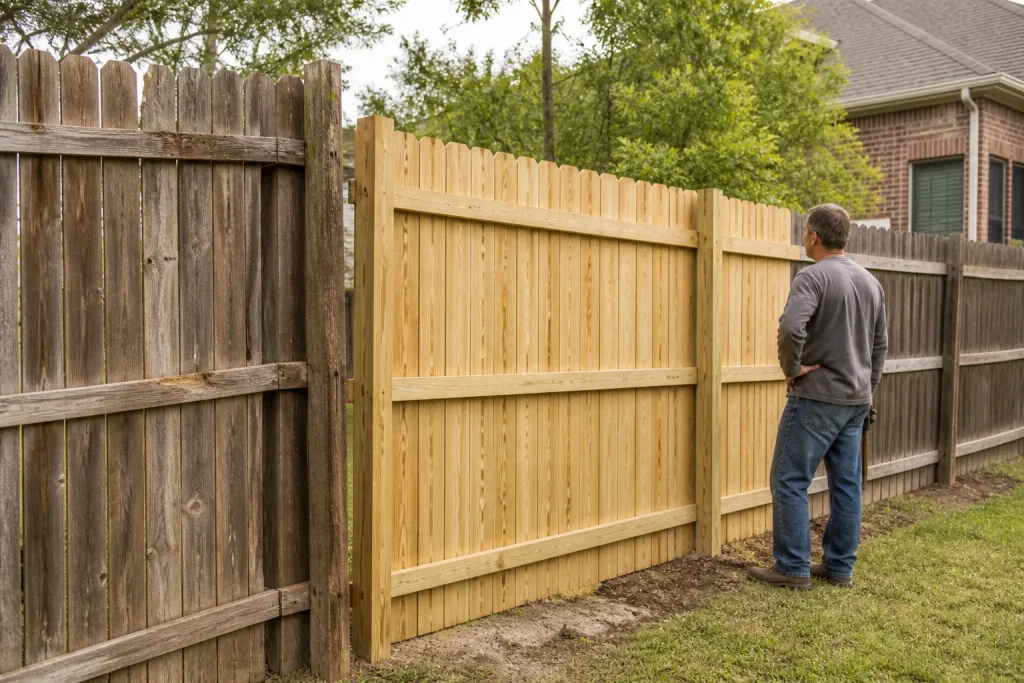
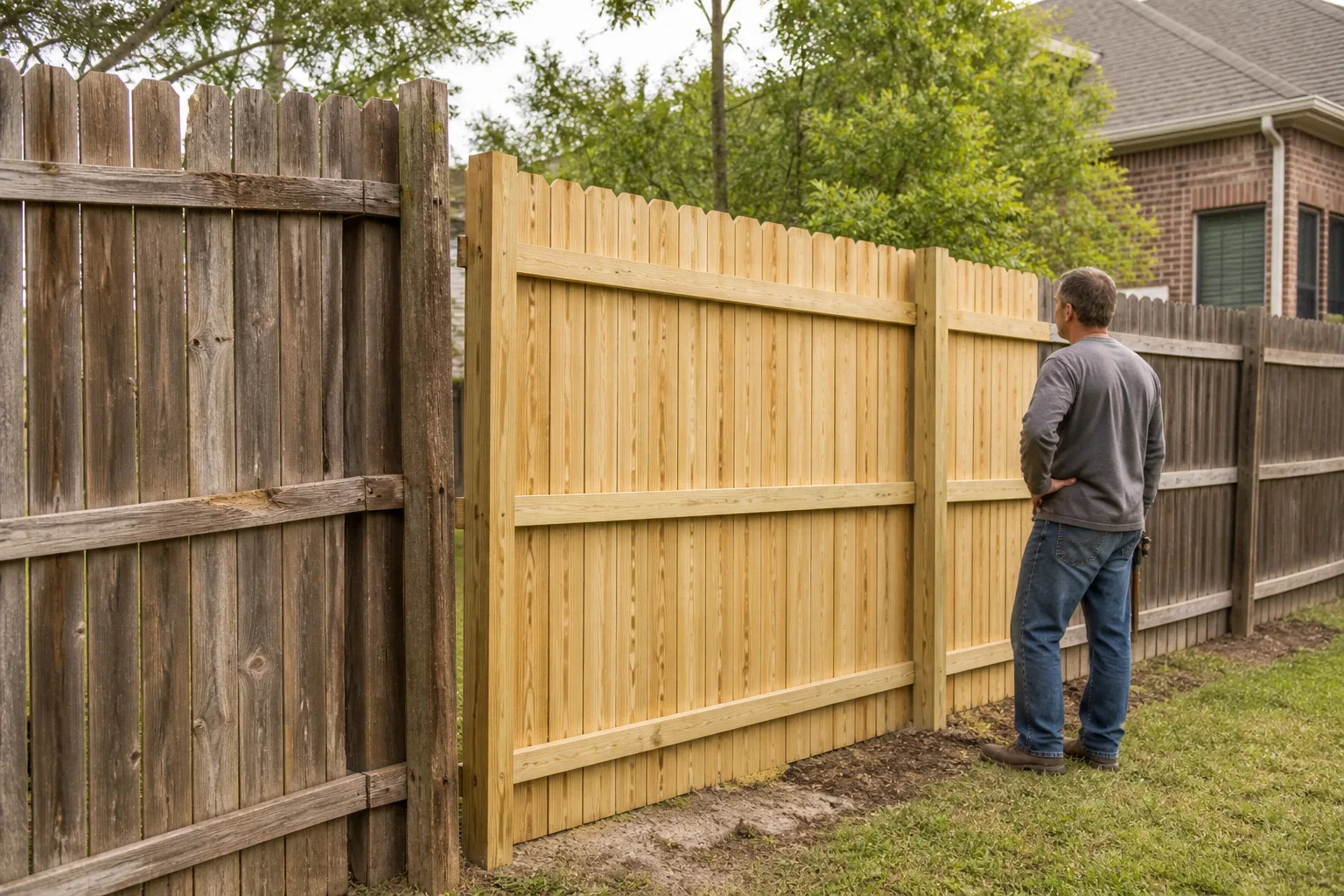
Fence Installation: Repair or Replace? How Dallas Homeowners Decide
A leaning fence post in Dallas isn’t a fence problem. It’s a soil problem. Fixing the post without addressing the clay heave underneath it guarantees you’ll be back out there with a post-hole digger within 18 months, usually right after the next wet spring. Dallas sits on expansive black clay that swells when it’s wet and shrinks when it’s dry, and that cycle pushes, pulls, and twists fence posts year after year. Knowing which failures are cosmetic and which are structural is the whole game.
What’s Actually Moving Your Dallas Fence?
Most fence damage in Dallas comes from the ground up, not the top down. The clay soil under most of the metroplex expands by as much as 30 percent when saturated and contracts hard in summer drought. That movement works on posts, rails, and panels constantly. Add the humidity-heat swing – 95°F July afternoons followed by 70°F nights, plus spring storms that dump two inches in an hour – and you’ve got a climate that stresses wood fencing in ways a homeowner in Phoenix or Seattle never deals with.
So when a Dallas homeowner sees a sagging gate or a leaning post, the question isn’t “what’s wrong with this fence?” It’s “how far has the underlying movement gone?” If it’s one post, you may be looking at a targeted repair. If it’s three posts across two spans, the rails are already telling you the whole run is shifting. That’s the fork in the road.
The Three Structural Signs That Mean Replace, Not Repair
We’ve seen hundreds of Dallas fences over the years, and three failure patterns reliably mean full replacement is the smarter spend:
- Post rot at grade. Not rot higher up – rot right at the soil line where moisture sits against the wood. If you can push a screwdriver into the post an inch with hand pressure at grade, that post is gone. In Dallas, treated pine posts typically last 8 to 12 years before this happens. If you’re seeing it on more than one post, expect the rest to follow within 24 months.
- Rail separation at multiple spans. One loose rail is a repair. Three loose rails across a run means the posts are pulling apart and the whole structure has lost its load path. Screws and brackets won’t fix a fence where the posts are creeping in different directions.
- Panel warping from clay heave. When cedar pickets cup and twist along the top rail and the gaps open unevenly, the panel is reacting to soil movement, not age. Replacing individual pickets is throwing money at a symptom. The soil is still moving.
If you see two of these three signs on the same fence line, replacement almost always wins the math.
How to Compare Repair vs. Replace Using Dallas Numbers
National averages lie. Dallas lumber pricing, local labor rates, and the specific demands of our soil and climate change the calculation. Here’s a realistic comparison based on what we see in Dallas:
- Reset a single post: $150 – $350 per post. Realistic lifespan gain: 2 – 4 years if the soil movement is localized. If three or more posts need it, this budget gets ugly fast.
- Replace a section (10 – 15 ft, cedar): $400 – $800 including posts, rails, and pickets. You’re buying time, not value, if the rest of the fence is more than 15 years old.
- Replace a full run (100 linear ft, cedar): $3,200 – $5,500 in Dallas, depending on height, gate count, and whether old material haul-off is included.
- Replace a full run in treated pine: $2,400 – $4,000. Cheaper upfront, shorter lifespan in our climate – see the material section below.
- Treated pine lifespan in Dallas: 10 – 15 years when properly set. Cedar: 15 – 20 years. That gap matters when you’re doing the math on a repair that buys three years vs. a replacement that buys seventeen.
The rule of thumb: if the repair cost exceeds 40 percent of a full replacement, and the fence is more than two-thirds of the way through its expected lifespan, replacement wins. Almost every time.
Cedar vs. Treated Pine: How Material Choice Changes the Decision
In Dallas, cedar and treated pine behave differently enough that the repair-or-replace math forks depending on what you already have.
Treated pine handles the wet side of Dallas weather fine, but it goes brittle fast in the summer heat. In our experience, treated pine in Dallas will show surface checking and split rails after 8 to 10 years of full sun, and its failure mode under clay heave is cracking rather than flexing. Once a treated pine rail splits, no amount of bracing brings it back to load-bearing. That means repairs on older pine fences are usually temporary patches.
Cedar flexes rather than cracks under the same soil movement, tolerates humidity swings better, and resists rot more evenly across the board. The catch: cedar is meaningfully more expensive per linear foot in Dallas (roughly 30 – 40 percent over treated pine). If your fence is cedar and less than 10 years old, a targeted repair on one or two posts is often the right call. If it’s cedar and 15 years old, replacement pays back faster.
One thing we don’t sell: “repair it with the cheapest pine” on a cedar fence. Mixing materials creates uneven weathering and the panels never line up again. If it’s worth saving, save it properly.
Dallas HOA Rules That Lock You Into Repair-Only Decisions
A fence replacement isn’t just a construction decision in Dallas – it’s a compliance decision. Many Dallas-area HOAs specify fence height (usually 6 ft max, side and rear), material (cedar, brick, or wrought iron most commonly), picket spacing, and finish color. Some historic-district HOAs in older neighborhoods are stricter still, and a few require architectural-review submission before work begins.
Why does this matter for repair vs. replace? Because some HOAs cap how often you can replace a fence, and others will approve a repair in a week but a full replacement in six. If you’re in a Dallas neighborhood where a full replacement means board review, and your fence has only one structurally compromised post, a proper repair with matching materials may be the only path the HOA will approve this year. We’ve pulled one out of a garage over in Lake Highlands where the HOA wouldn’t approve a full replacement mid-quote cycle – a well-executed repair on the two failing spans bought the homeowner 18 months to get through the review properly.
Check two things before you sign a bid in Dallas: your HOA’s architectural rules, and whether the fence sits on a property line you share with a neighbor. Texas law doesn’t force a neighbor to split fence costs, so if you’re replacing a shared fence, get a written agreement first. Skipping that step is where most fence disputes in Dallas start.
When to Call a Pro (and When Not To)
A gate that needs re-hinging or a single picket swap is fine to handle yourself. What we don’t recommend for homeowners is digging out and resetting a post on a fence that’s over 10 years old, especially in North Texas clay. Once you get a post out of the ground, the concrete collar has often cracked, the adjacent posts have already shifted, and by the time you’ve reset one post you’ve started a domino you can’t stop. That’s how a $300 repair turns into a $4,000 replacement you didn’t plan.
We also want to flag a safety point: any fence work near overhead power lines, gas meters, or on a slope that could collapse under you is real risk. Get a professional out. The math usually works out cheaper anyway.
Related services in Dallas: if the soil movement is what got you here in the first place, look at Fence Installation in Dallas and our Driveway & Pavers in Dallas work – we build both to handle North Texas clay correctly from the ground up.
The Bottom Line
Repair wins when one structural element has failed and the underlying fence has more than half its lifespan left. Replace wins when two of the three structural signs are present, when the repair cost is more than 40 percent of replacement, or when the existing fence sits on shifting Dallas clay that no repair will fix. If you’re in Dallas and want a straight answer on which way to go, Groundwork Construction Co. of Dallas offers free estimates with written, line-item pricing and a site assessment that accounts for soil conditions, not just what’s above the ground. And if you’re planning broader yard or home work, our Home Additions & ADU in Dallas team handles the full-scope builds that often pair with a fence replacement. Call (844) 797-4808 for a free estimate – calls are answered by a live person 24/7, and every project is backed by our 730-Day Done Right Promise.
Frequently Asked Questions
A full fence replacement in Dallas typically runs $2,400 – $4,000 for 100 linear feet in treated pine, or $3,200 – $5,500 in cedar. Actual cost depends on height, gate count, old material haul-off, and site-specific soil conditions. Call (844) 797-4808 for an exact quote – estimates are free and line-itemed.
Only if the post failure is isolated and the surrounding spans are stable. In Dallas, leaning posts usually mean clay heave is moving the whole run, and resetting one post buys 18 months at best before the next one fails. Ask a contractor to check adjacent posts before you authorize a repair.
Yes. Cedar typically lasts 15 – 20 years in Dallas versus 10 – 15 for treated pine, because cedar flexes instead of cracking under clay movement and handles Houston-humidity swings better. Over a 20-year window, cedar usually costs less per year of life despite the 30 – 40 percent premium upfront.
Usually yes, but plan for the architectural-review timeline – some Dallas HOAs approve replacements in six weeks, others require board vote. If you’re in the middle of a review cycle, a targeted repair that keeps the fence structurally sound may be your only compliant option this year. Call (844) 797-4808 and we’ll walk through what your HOA needs on paper before any work starts.
Written by the team at Groundwork Construction Co. of Dallas.
Need Construction Help?
Call Groundwork Construction Co. of Dallas - licensed & insured, here with fast after-hours help in Dallas.
(844) 797-4808